
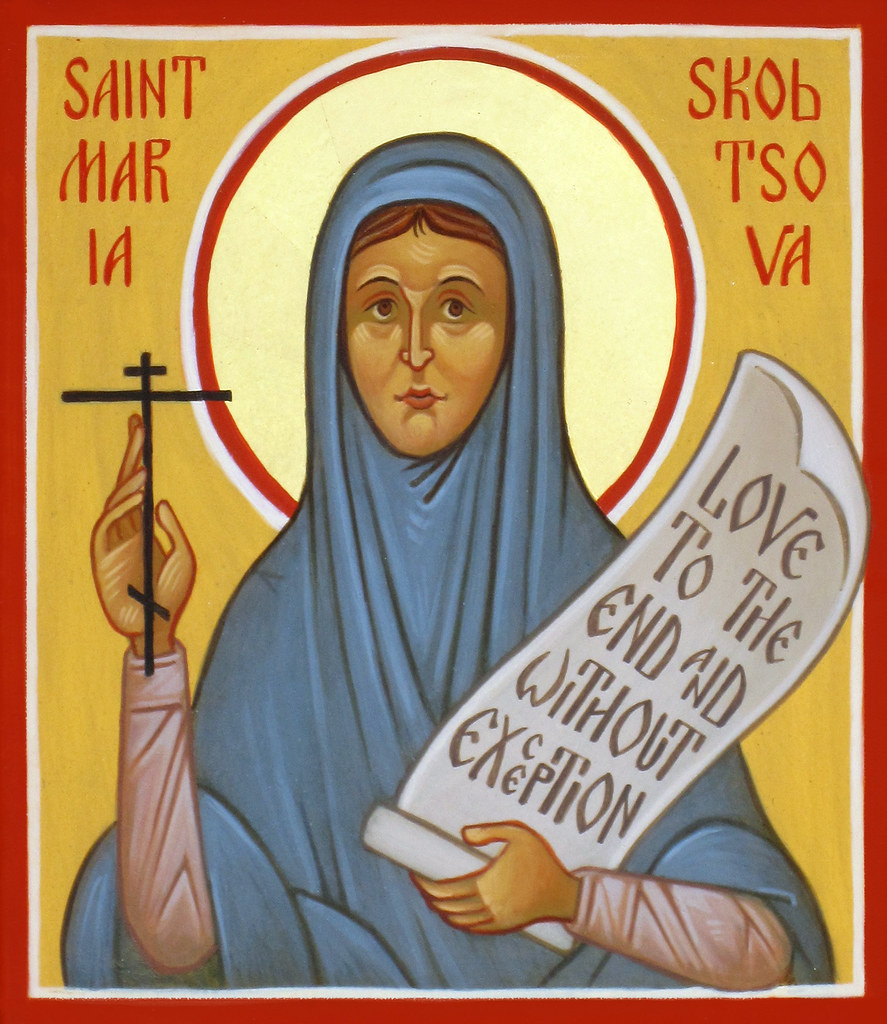
Commemorated July 20th (New Calendar)
Saint Maria Skobtsova, born Elizaveta Pilenko in 1891 in Riga, Latvia, lived a life full of compassion, courage, and devotion to others. From her early years to her heroic acts during World War II, she showed what it means to love your neighbor. Her journey took her from a comfortable childhood to the horrors of a Nazi concentration camp, where she died as a martyr in 1945. This is her story, told simply, so you can see how one woman’s faith changed lives.
Early Life: A Faithful Beginning
Elizaveta grew up in Anapa, Russia, by the Black Sea. Her parents were devout Orthodox Christians, and their faith shaped her deeply. As a kid, she once gave all her savings to help paint an icon for a new church. At seven, she asked her mom if she could be a nun. A year later, she dreamed of being a pilgrim, walking from shrine to shrine. Her faith was strong, but tragedy struck when her father died in 1905. This shook her, and at 14, she turned to atheism, thinking, “If there’s no justice, there’s no God.”
Teenage Years: Searching for Truth
In 1906, her family moved to Saint Petersburg, a city buzzing with ideas. Elizaveta, now a teen, joined radical literary groups and met poets like Alexander Blok. She was drawn to revolutionary ideas but found them empty. People talked about change, yet no one acted. She wanted to fight injustice, even die for it, but saw others just debating over breakfast. Still, her heart began turning back to Christ, not as God yet, but as a heroic figure.
Young Adulthood: Marriage and Motherhood
In 1910, Elizaveta married Dimitri Kuzmin-Karaviev, a Bolshevik, out of pity more than love. Their marriage fell apart by 1913, the same year she welcomed her daughter, Gaiana. She moved back to southern Russia, where her faith grew stronger. During World War I, she wore a heavy belt to remind herself of Christ’s suffering and others’ pain. But she soon learned true Christian life meant helping others, not just punishing herself.
Saint Maria’s Calling: Revolution and Exile
By 1917, the Russian Revolution changed everything. Elizaveta was in Saint Petersburg when the Bolsheviks took over. She heard harsh words from leaders like Leon Trotsky, dismissing her political group. As deputy mayor of Anapa in 1918, she faced arrest for helping those in poverty, not picking sides. Her judge, Daniel Skobtsov, spared her life, and they later married. As the war turned against them, they fled to Georgia, where her son Yura was born in 1920, then to Yugoslavia, where her daughter Anastasia was born in 1921. In 1923, they settled in Paris.
Motherhood for All: Becoming Saint Maria
In Paris, tragedy struck again when Anastasia died in 1926. Heartbroken, Elizaveta found new purpose: to be a “mother for all” who needed care. She joined the Russian Student Christian Movement, diving into social work and writing about saints. In 1930, she became the group’s traveling secretary, helping poor Russian refugees across France. Her bishop, Metropolitan Evlogy, saw her heart for service and suggested she become a nun. In 1932, she took her vows, becoming Mother Maria, dedicated to “monasticism in the world.”
Saint Maria’s Mission: Houses of Hospitality
Mother Maria started a house at 9 Villa de Saxe in Paris to help jobless Russian women. She gave up her own room, sleeping in the basement. The dining room became a lecture hall, and she painted icons for a small chapel. By 1934, she moved to a bigger place to feed more people—up to 100 a day. She begged for food or bought it cheap. Her rule was simple: “Each person is the icon of God.” She opened more homes, a sanatorium, and even visited mental hospitals to free wrongly held Russians.
World War II: Courage Under Occupation
When Germany occupied France in 1940, Mother Maria stayed in Paris despite the danger. She and Father Dimitri Klepinin turned her house into a food distribution point. They helped Russian prisoners and Jews, even issuing fake baptismal certificates to save them. In 1942, when thousands of Jews were rounded up, Mother Maria sneaked into a stadium to comfort them, smuggling out children in trash bins. She and her team also set up escape routes to safer areas.
Arrest and Imprisonment: Saint Maria’s Sacrifice
On February 8, 1943, the Nazis arrested her son Yura, Father Dimitri, and others after finding a letter about false documents. Mother Maria was arrested the next day. They were sent to Compiegne, then to camps in Germany. Mother Maria ended up in Ravensbruck, where she endured two years of brutal conditions. She stayed cheerful, helping others despite roll calls in freezing winters and little food. She worked hard, from dragging heavy rollers to knitting, always caring for those around her.
Martyrdom: Saint Maria’s Final Days
By early 1945, Ravensbruck grew worse. Food ran low, and a gas chamber was built. On March 30, 1945—Good Friday—Mother Maria was chosen for death. Some say she took another’s place, a Jew, in the gas chamber. She died the next day, Holy Saturday, at age 53. Her son Yura and Father Dimitri had died earlier in other camps. Yet her spirit lived on through those she helped, who shared her story after the war.
Legacy: Saint Maria’s Canonization
After the war, books and a Russian film in 1982 spread Mother Maria’s story. Her writings and acts of love inspired many. On January 18, 2004, the Orthodox Church named her Saint Maria Skobtsova, along with Yura, Father Dimitri, and their friend Ilya Fondaminsky. Her life shows how faith and action can shine even in the darkest times.