
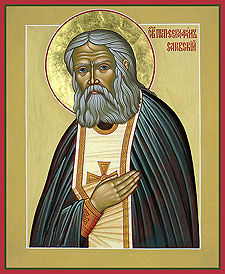
Commemorated Jan 2
Saint Seraphim of Sarov, born Prochorus Moshnin on July 19, 1754, in Kursk, Russia, lived a life full of prayer and miracles. His journey as a monk and wonderworker inspires many in Orthodox Christianity.
Early Life of Saint Seraphim
Prochorus grew up in a pious family. His father, Isidore, a merchant, died young, leaving his mother, Agathia, to raise him. At seven, he fell from a bell tower but was unharmed, a sign of God’s protection. He loved reading the Bible and saints’ lives, often praying alone. When gravely ill, he saw the Virgin Mary in a dream, promising healing. Soon after, he kissed a holy icon during a procession and recovered.
Becoming a Monk
As a teenager, Prochorus decided to dedicate his life to God and changed his name to Seraphim. His mother blessed him with a copper cross he wore always. In 1778, at 24, he joined the Sarov monastery. There, he worked hard, serving Elder Joseph and doing tasks like baking bread. He fasted strictly, eating once a day and never on Wednesdays or Fridays. Therefore, his faith grew stronger through discipline.
Saint Seraphim’s Wilderness Years
In 1794, Saint Seraphim moved to a forest cell, living alone for 15 years. He read the Gospels weekly, sang hymns, and gardened. Bears and wolves became his friends, eating from his hand. For 1,000 nights, he prayed on a rock, mimicking Saint Simeon the Stylite, saying, “God, be merciful to me, a sinner.” However, robbers once beat him badly, but he forgave them. The Virgin Mary healed him after this attack.
Miracles and Guidance
By 1810, Saint Seraphim returned to the monastery, living in silence for years. In 1825, the Virgin Mary told him to help others. He opened his cell to pilgrims, greeting all with “Christ is Risen, my joy!” His prayers healed many, and he saw into people’s hearts. For example, he explained to Nicholas Motovilov that the Christian life’s goal is gaining the Holy Spirit. During this talk, both shone with divine light.
Caring for Diveyevo
Saint Seraphim guided the Diveyevo women’s monastery, calling its nuns his “orphans.” He followed the Virgin Mary’s instructions, helping with their spiritual and daily needs. His love and miracles, like healing benefactor Michael Manturov, strengthened the community. Thus, his care left a lasting impact.
Final Days and Legacy
In 1833, Saint Seraphim grew weak. He often sat by his coffin, ready for death. On January 2, 1833, he died kneeling in prayer before an icon. Smoke from smoldering books signaled his passing, as he’d predicted. Orthodox Christians honor him on January 2 for his holy life.