
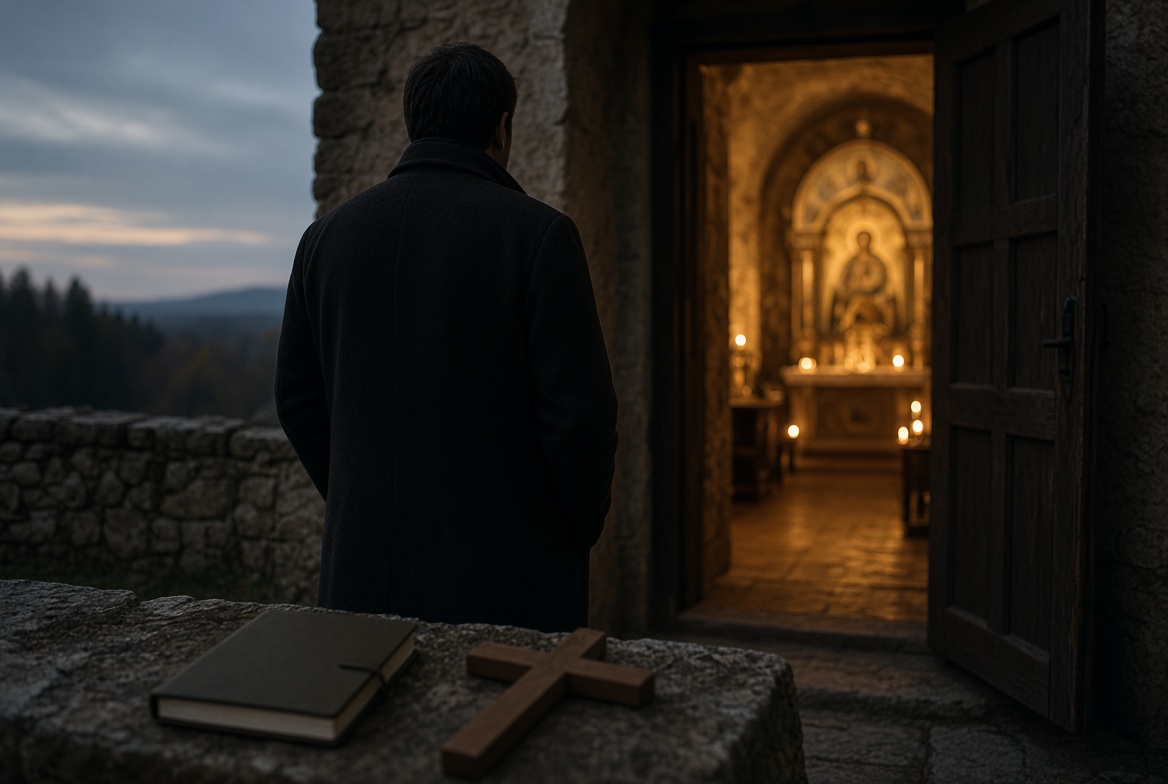
The mind is for questions. That is not a modern slogan. Philip met a man on the road who was reading and did not understand, and the man asked to be taught. Nicodemus came at night. Thomas would not say he had seen what he had not seen. The Church did not throw them out for asking. It answered, and then it baptized.
“Question everything” is a true sentence if it means: do not live on a headline, do not nod because the room nodded, do not hand your mind to a screen. It becomes a lie if it means there is no truth to arrive at, and no one who may teach you. A question that cannot end is not courage. It is a way of never having to obey.
An inquirer is already in the right posture. He has heard a claim about Christ, the Trinity, the saints, the fasts, and the Liturgy, and he is allowed to ask why. The brave path is not a private theory. It is to take the question to the parish, to the services, and to a priest, and to stay long enough to hear the answer in the prayers as well as in the words. Come and see was the first invitation. It still is.
A catechumen has begun to be taught. His work is not to invent a smaller Orthodoxy he can manage. It is to learn what the Church actually says, and to ask when he does not yet understand. The Creed is not a rumor. The canons are not a comment thread. A hard teaching can be asked about. It should not be edited in private so that baptism will feel easier.
The newly illumined has the opposite temptation. The water is recent. Everything is bright, and a bright mind can turn the parish into a test it must pass. He will hear a sermon he dislikes, meet a rude person, and find a custom he was not told about. Those are real. They are not a reason to go back to questioning as a substitute for the life. The cure is the next Liturgy, confession, and a question asked of someone who will still be there next week.
A person baptized years ago can fall asleep inside the answers. Familiarity does that. The prayers become noise. The fast becomes a family habit with the meaning worn off. Questioning, for him, is not a hunt for a hidden Church. It is the old work of attention: what did I just say in the Creed, and do I mean it?
A priest’s child knows the building too well. He has seen the vestry, the fatigue, and the gap between the icon and the man. That knowledge can become contempt, and contempt feels like insight. It is not. He is allowed to ask what his father cannot explain at dinner. He is not required to despise the altar because he grew up beside it. Many saints were ordinary sons and daughters of ordinary houses. The Church did not begin in a performance.
A priest, or anyone in the clergy, is not past questions. Study is a form of them. So is the honesty of confession. What he may not do is perform his doubt for a crowd, or teach his unresolved quarrel as the faith. The people in front of him did not come to watch a mind refuse to land. They came to be given what he received. If he is tired, or angry, or unsure, that belongs in prayer and with his bishop or his confessor, not in a slogan about questioning everything.
People shut a question down when they are afraid. That happens in parishes. It also happens in the person who calls every settled teaching a lie because a settled teaching would ask something of him. Final answers can be laziness. Endless questions can be the same laziness in a braver coat.
So ask. Ask why this story, who is served by it, and what was left out. Ask it of the headline, and ask it of your own suspicion. Then bring the question that remains into the Church, where Thomas was allowed to touch, and where he ended by saying, My Lord and my God.
A website cannot pastor you. Find a parish.
Leave a Reply